K9 Dogalogue Start your dog’s assessment

Mandurah & the Peel region

Dog training in Mandurah, built around the dog you want to live with.

The puppy won’t stop biting. The walk is a fight. Recall vanishes the moment something better turns up. Every other dog on the street sets yours off.

That’s usually why people find us. It’s where we start, not where we stop.

Start with your dog, not a package.

Two dogs that pull on the lead can need completely different training. One has never been shown how to walk with a person. The other is overwhelmed by traffic and other dogs and the pulling is a symptom. You shouldn’t have to work out which one you’ve got.

The assessment does that. Tell us about your dog, what’s going wrong, and what you’d like to be able to do together, and we’ll tell you where they fit.

Six certificates. One pathway.

K9 Dogalogue training is built around six certificates that take a dog from foundations to genuine real-world reliability, and take the owner with it. Fix the problem, and build the dog underneath it.

Each certificate develops a different part of a capable dog. Real dogs don’t fit neatly into one box, and neither does their training — a problem you’re seeing now can sit across two or three of these, which is why the assessment comes first.

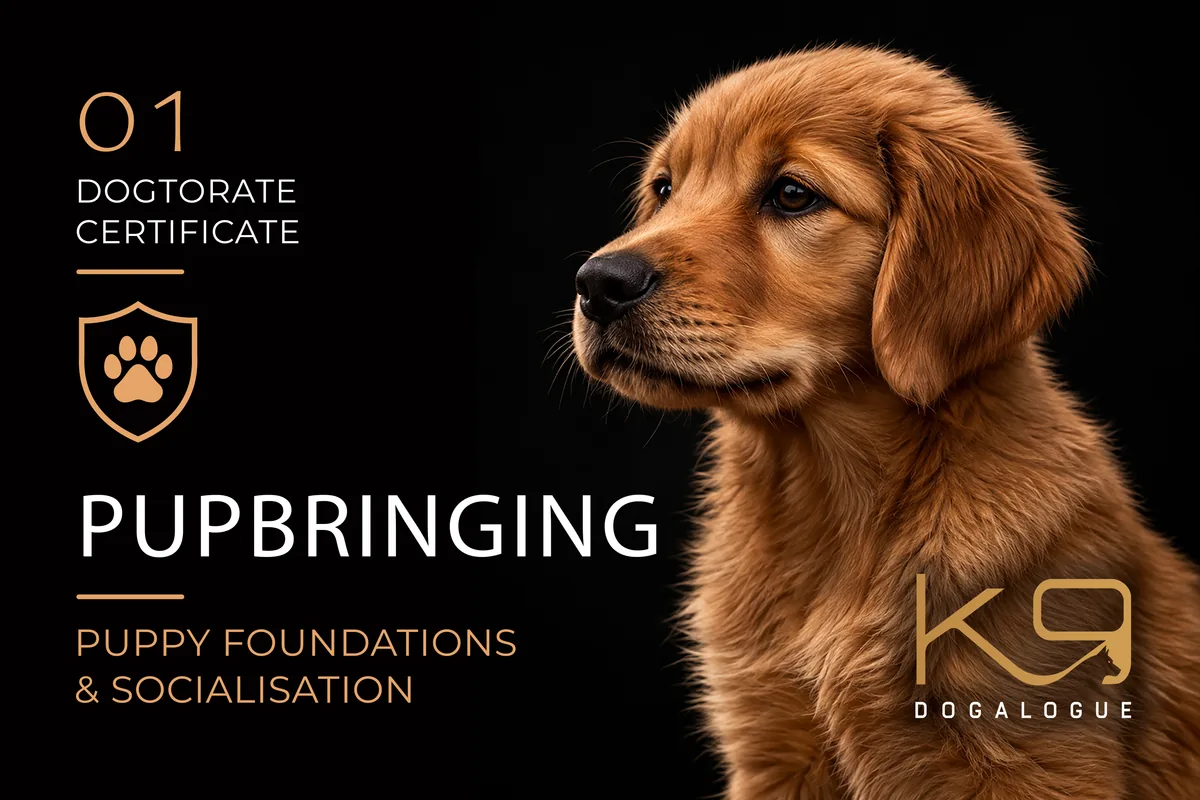
01

Pupbringing

Puppy foundations and socialisation

Biting, toilet training, chewing, crying in the crate — the puppy stage is mostly about getting through it. Pupbringing does that, and uses the time to build the communication, confidence and socialisation that stop puppy problems turning into adult habits.

02

Dogma

Obedience and everyday manners

Sit and drop aren’t the hard part. Getting a dog to listen when there’s something more interesting going on is. Dogma builds the manners that make living together work — jumping on visitors, barking, door-dashing, the adolescent dog that’s stopped listening — and teaches you how to hold them once the trainer has gone home.

03

Leashurely

Loose-lead walking

Walking your dog should be the easy part of the day. Leashurely builds loose-lead walking and real engagement, so the lead connects you to your dog instead of restraining it. Pulling is usually where it starts. For some dogs the lunging, frustration or nerves around traffic and other dogs are the actual work.

04

Total Recall

Recall and off-lead reliability

A “come” that works in the kitchen isn’t recall. Total Recall builds it across distance and distraction, at the park, beach and bush where it actually matters, so more freedom for your dog doesn’t mean more risk. If your dog won’t come when called, or only comes when there’s nothing better on offer, this is where that gets fixed.

05

Unfazed

Reactivity, anxiety and emotional regulation

Some dogs feel the world harder than others. Barking and lunging at other dogs, guarding food or toys, distress when left alone, shutting down somewhere new — what looks like bad behaviour usually has fear or frustration underneath it. Unfazed works on what’s driving the behaviour, not just the display.

06

Bombproof

The final exam

Not a new set of problems. Bombproof takes everything built across the other five and proves it holds: busier places, bigger distractions, the school pickup and the Sunday market, the situations you can’t script. A behaviour you can rely on when things get messy is a different achievement from one performed in the lounge room.

What we help with

Most dogs arrive with one of these. Many arrive with several.

Puppies

A new puppy and no idea where to start. Puppy biting and nipping. Toilet training that’s stalled or gone backwards. Crate training, chewing, jumping up, a puppy that won’t settle or won’t walk on the lead. Scared of the vacuum, the car, the stairs. Fear periods that look like a problem and aren’t. Introducing a puppy to kids, cats or the dogs already in the house.

Manners

Won’t listen. Jumps on visitors. Steals food off the bench. Digs up the yard. Barks at the door, the window, or nothing. Hyperactive indoors, won’t stay off the couch, ignores the sit, stay and drop it supposedly knows. Listens to one person in the house and not another. The adolescent dog, six to eighteen months, that has forgotten everything.

Walking

Pulling on the lead. Lunging at dogs, cars, bikes or joggers. Lead reactivity — fine off-lead, a nightmare on it. Refusing to walk. Too excited to get past anything. Two dogs at once, one of them pulling. Panicking when the harness comes out.

Recall

Won’t come when called. Perfect at home, deaf at the park or beach. Chases birds and wildlife. Bolts through open gates. Only comes for treats. Runs off and doesn’t come back.

Reactivity and anxiety

Reactive to other dogs, or to men, kids, bikes or uniforms. Resource guarding. Separation anxiety. General nervousness — pacing, panting, can’t settle. Storms and fireworks. Car anxiety. Vet and groomer fear. A rescue dog with a history you don’t know. Tail chasing, shadow chasing and other compulsive behaviour.

Confidence

Timid dogs. Dogs that fall apart in busy places, on new surfaces or around new sounds. Dogs that freeze rather than react. Dogs that are fine at home and lost everywhere else. Working breeds — kelpies, shepherds, Malinois — with nowhere to put their drive.

Households

More than one dog and conflict between them. A new baby on the way. A new dog joining a house that already has one.

Serious behaviour

Aggression, bite incidents and fighting between dogs in the same house are not do-it-yourself problems, and you won’t find how-to content on them here. They are assessable. Start there, not on YouTube.

When it’s not a training problem

A sudden change in a previously settled dog, or an older dog behaving differently, is a vet visit first. Pain and illness produce behaviour. If the vet clears them, we take it from there.

Training you can see

You shouldn’t have to take a trainer’s word for it that your dog is improving.

K9 Dogalogue starts with a proper intake so the work is based on the dog in front of us. If we go ahead, progress is planned, recorded and reported so you can see what was worked, what passed and what still needs proofing.

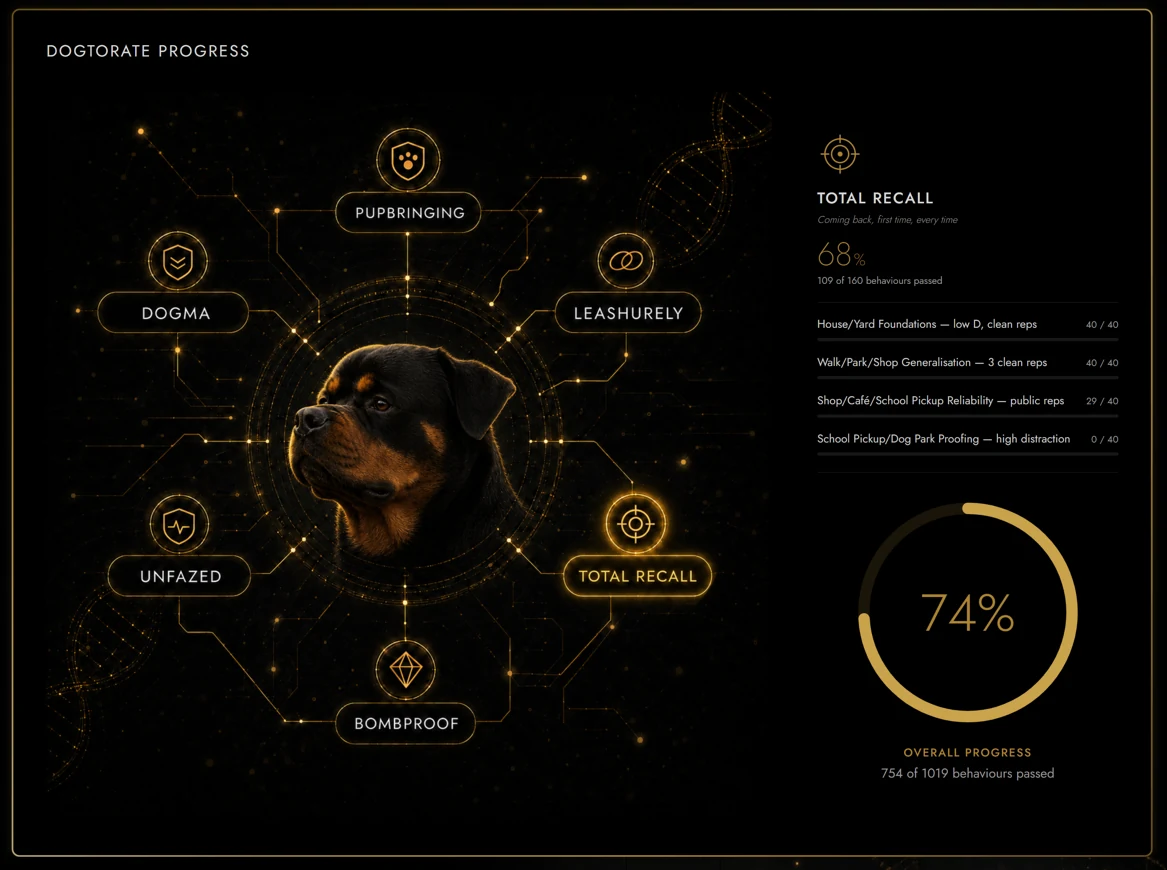
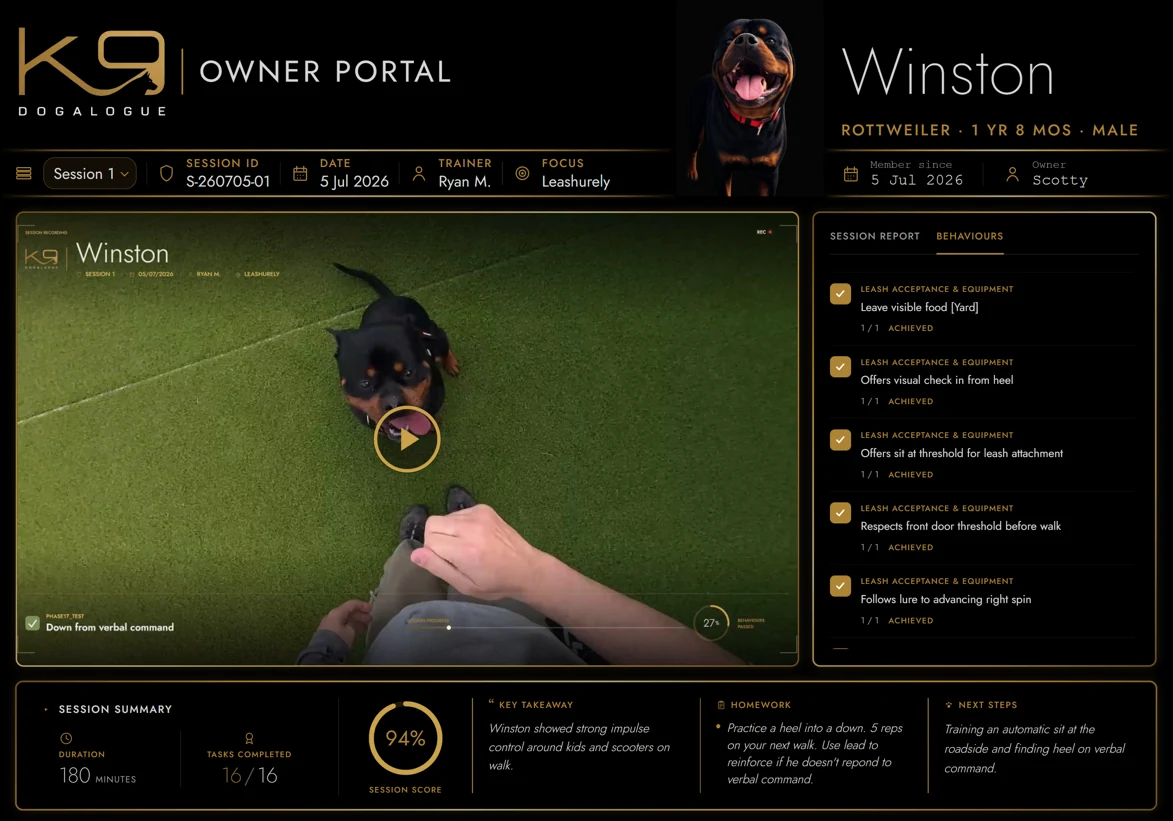
Every dog trained with K9 Dogalogue has an Owner Portal — their training record, session results, progress toward each certificate, homework and feedback in one place. Where it helps, session video shows you what was trained, how it developed and what it looks like when it works.

That matters because the job isn’t to get your dog to do something for us. It’s to make sure you can get it too. The end product is a more capable dog and a more capable owner, not a standing appointment with a dog trainer.

  • A private intake that lets you explain what is actually happening.
  • A starting snapshot before any pressure to leave contact details.
  • Limited active places so accepted dogs get proper planning, reporting and follow-up.
  • Reports that show progress in plain English, not trainer jargon.
The K9 Dogalogue owner portal showing a dog's behaviour progress summary A K9 Dogalogue session report with behaviour notes and homework
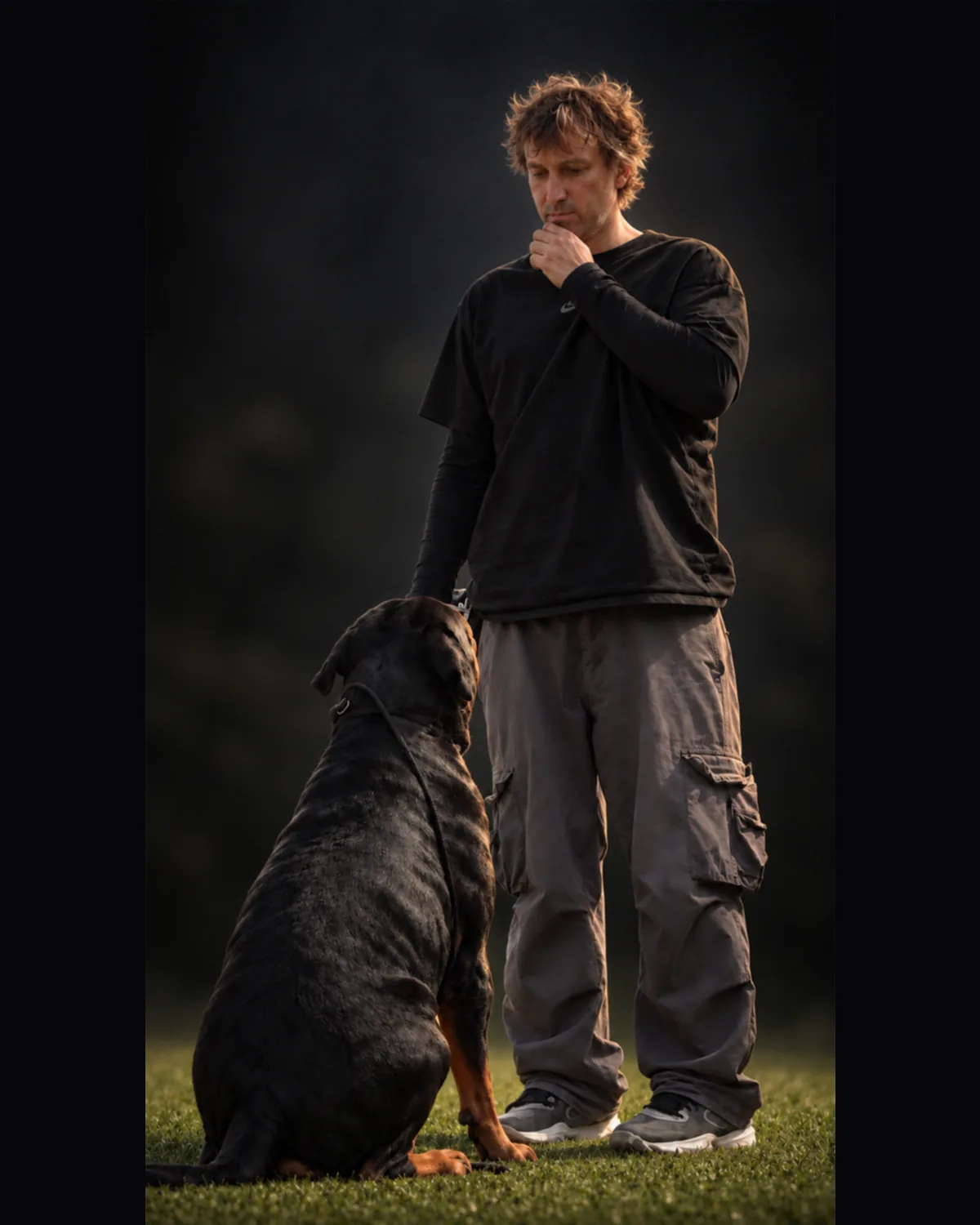
Ryan McKenzie, K9 Dogalogue, standing with a Rottweiler sitting at heel

Ryan McKenzieTrainer & founder, Meadow Springs WA

About K9 Dogalogue

Built for clear progress.

I built K9 Dogalogue because dog training should be easier to understand from the owner's side: what is being worked, why it matters, what changed and what comes next.

My focus is practical handling, honest reporting and structured progression. No magic fixes. No vague promises. Just a clear plan for the dog in front of us, worked carefully and recorded properly.

Questions people ask before they start

Do I have to do all six certificates?

No. The assessment tells you where your dog fits now, and most dogs start with one. Whether you go further is your call — the pathway is there when you want it.

My dog is an adult. Is it too late?

No. Pupbringing is the only certificate tied to age. Everything else is built for the dog in front of us, at whatever age they are.

Where do you train?

Mandurah, Meadow Springs, Dudley Park, Greenfields, Erskine, Falcon, Halls Head, Wannanup, Lakelands and Coodanup. Sessions happen where the behaviour happens — your home, your street, the park, the café — because a dog that’s good in a training hall isn’t the goal.

Do you train the dog, or me?

Both. A dog that only works for the trainer isn’t trained. Every session is built so you understand what was done, why it worked, and how to do it yourself.

My dog has bitten someone. Can you help?

Possibly, but not from a web page. Start with the assessment and be honest in it — it’s the only way to find out what’s realistic.

Don’t just fix this problem.

Imagine the next one never becoming a problem. Enjoying the walk instead of surviving it. Calling your dog and knowing they’re coming. Taking them somewhere new without wondering how the day ends.

That’s the dog we’re interested in building, and the assessment isn’t a commitment to six certificates. It’s where we find out about the dog you have today and work out where you could go together.

What are you struggling with? What would you change? What would you love to be able to do together? It starts there.

Ryan McKenzie trading as K9 Dogalogue · ABN 41 468 909 954
Training by appointment — at our Meadow Springs training location, out in the field, and in-home across Mandurah & surrounds, WA.
Not a public premises: no walk-ins, and drop-off or pick-up by appointment only.
0424 161 414 · trainer@k9dogalogue.com.au · Privacy

© 2026 K9 Dogalogue · Mandurah WA. All rights reserved — content on this site may not be reproduced without permission.